Clinuvel (CUV) Deep Dive: Bitopertin, Vitiligo and a Business Priced at 3.4x Operating Profit
Clinuvel rose 9.3% to $7.74 on 5 November 2026, a week after a two-year low. Cash covers 64% of the share price, SCENESSE earns 43% operating margins, and Disc Medicine's enterprise value is roughly 24 times Clinuvel's with no revenue. A full look at bitopertin, the December vitiligo readout, the new delivery platform, every recent announcement, broker targets, and a whole-business cash flow and sum-of-the-parts model.
Clinuvel Pharmaceuticals (CUV) closed at $7.74 on Thursday 5 November, up 9.3% from $7.08. Eight trading days earlier, on 26 October, it closed at $7.01, its lowest close in at least two years. The stock had fallen 47% from its December 2025 closing high of $13.23.
There was no ASX announcement today. The AGM is tomorrow, and topline results from Clinuvel's first late-stage vitiligo trial are due next month.
The numbers make Clinuvel look cheap. Of the $7.74 share price, $4.99 is cash. The remaining $2.75 a share, about A$139m in total, buys a business that made A$40.5m in operating profit last year, plus a Phase 3 vitiligo program, a generic ACTH product under review in Europe and a new drug delivery platform. Meanwhile Disc Medicine, whose bitopertin pill is about to compete with Clinuvel's only product, raised US$450m last month at a valuation of about US$3.3bn, with no revenue.
The question this post tries to answer is whether that's a mispricing, or whether the market is correctly pricing in a business about to lose its monopoly. We built a cash flow model of SCENESSE in EPP under three competitive scenarios, then valued every other program in the pipeline on a risk-adjusted basis and added them up.
The short answer: on our numbers the whole business is worth between $10.63 and $15.58 a share, depending on how much of the EPP market bitopertin takes. $7.74 only makes sense if bitopertin takes most of the market and vitiligo has less than a 10% chance of reaching patients. The brokers who have updated since August are much closer to the market than we are, at $7.00 to $11.50, and the reasons for that gap are set out below.
The numbers at $7.74
| Metric | Value |
|---|---|
| Shares on issue | ~50.5m |
| Market cap | ~A$391m |
| Cash and term deposits (30 June 2026) | A$252.1m |
| Debt | Nil (A$1.9m of lease liabilities only) |
| Enterprise value (market cap less cash) | ~A$139m |
| FY26 revenue | A$94.0m |
| FY26 operating profit (before interest) | A$40.5m |
| FY26 net profit after tax | A$33.9m |
| P/E | 11.4x |
| EV / operating profit | 3.4x |
| EV / after-tax profit excluding interest income | 5.2x |
| Cash per share | $4.99 (64% of the share price) |
| Net tangible assets per share | $5.35 |
For a profitable, debt-free specialty pharma company with an 83% gross margin, 3.4x operating profit is a very low multiple. Markets don't usually price businesses this way unless they believe the profit is about to shrink. In Clinuvel's case, they have a specific reason.
How the price got here
| Date | Event | Move on the day |
|---|---|---|
| 19 Dec 2025 | 12-month closing high | $13.23 |
| 16 Feb 2026 | First trading day after the FDA rejected Disc Medicine's bitopertin (13 Feb, US time) | +11.9% |
| 26-27 Feb 2026 | Half-year results: revenue +4%, profit -26% | -3.2%, then -9.3% |
| 2 Apr 2026 | AAD 2026 highlights | -7.4% |
| 27-28 Aug 2026 | FY26 results and plan to delist from ASX for Nasdaq | -13.3%, then -7.7% |
| 20 Oct 2026 | First ASX session after positive Phase 3 bitopertin results | -0.8% on 466,555 shares (about 3x normal volume) |
| 26 Oct 2026 | Lowest close in two years | $7.01 |
| 5 Nov 2026 | No announcement, AGM tomorrow | +9.3% to $7.74 |
The bitopertin rejection in February was the best day of the year, and the stock has fallen 41% since then, from $11.86 to the October low. The largest single drop came with the August result and the delisting announcement (-20% over two days). The stock then slid again after Disc's Phase 3 data in October.
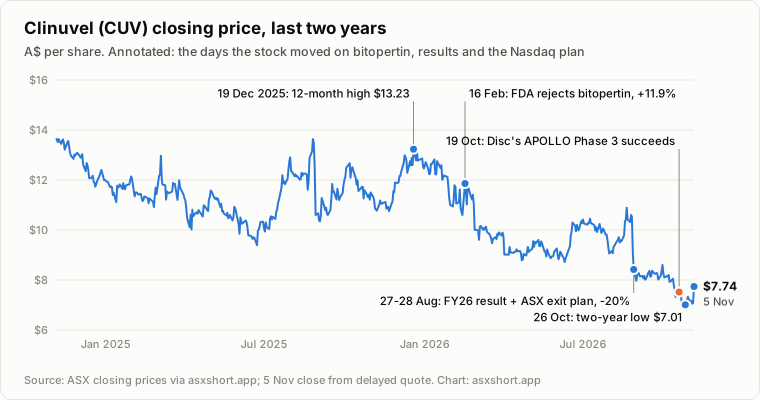
Source: ASX closing prices via ASXShort.app. The 5 November close is from a delayed third-party quote.
Today's move came on 178,360 shares, close to the 3-month average of about 153,000. That's a strong move on ordinary volume, without the heavy trading you'd expect on news. With 9% of the stock sold short (see below), some short covering ahead of the AGM is plausible, but ASIC's position data for today won't be out until next week. Today's price data is from Yahoo Finance's delayed quote: open $7.28, range $7.20 to $7.75.
The business: one drug, one disease, two regions
Clinuvel sells one product. SCENESSE (afamelanotide 16mg) is a dissolving implant placed under the skin, used to prevent the light-induced pain and burns of erythropoietic protoporphyria (EPP). EPP is a rare inherited metabolic disorder that Clinuvel estimates affects 5,000 to 10,000 people worldwide. SCENESSE is the only drug approved for EPP anywhere: in the EU (2014), the US (2019), Australia (2020), Israel and Canada (July 2026).
FY26 profit and loss
| A$m | FY26 | FY25 | Change |
|---|---|---|---|
| Revenue | 94.0 | 95.0 | -1% |
| Cost of revenue | 15.8 | 14.8 | +7% |
| Gross margin | 78.2 (83.2%) | 80.2 | -2% |
| R&D | 18.1 | 20.7 | -13% |
| General and administrative | 11.2 | 9.3 | +20% |
| Communications and marketing | 8.4 | 8.9 | -5% |
| Operating profit | 40.5 (43.1%) | 41.3 | -2% |
| Interest income | 10.4 | 9.4 | +11% |
| Unrealised FX loss | (4.0) | 0.9 gain | |
| Profit before tax | 47.7 | 51.6 | -8% |
| Profit after tax | 33.9 | 36.2 | -6% |
Where the revenue comes from
| A$m | FY26 | FY25 | Change |
|---|---|---|---|
| Ireland (Clinuvel's European distribution hub) | 52.5 (56%) | 46.2 (49%) | +13.6% |
| United States | 40.7 (43%) | 47.9 (50%) | -15.0% |
| Rest of world | 0.8 | 0.9 |
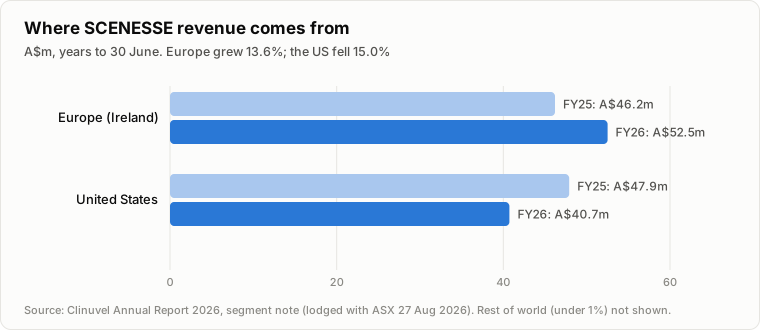
Source: Clinuvel Annual Report 2026, segment note.
This split matters more than anything else in the result. Europe grew 13.6%. Clinuvel says European treatment volumes rose 13%, helped by the EMA's September 2025 decision allowing up to six implants a year. US revenue fell 15%, and the company was direct about why: "some patients participated in competitor clinical studies and compassionate use programs where investigational therapies were supplied without charge." Part of the US decline in Australian dollars is also currency. The A$ rose against the US$ over the year, though the company doesn't split out how much of the fall that explains.
So the US decline was already showing up in the accounts before bitopertin was approved. The competitor was taking patients through its trials and expanded access programs. Overall treatment volumes still rose 6% globally, which shows the core product isn't shrinking. But the US market is where Clinuvel faces competition first.
Cash flow
| A$m | FY26 | FY25 |
|---|---|---|
| Receipts from customers | 99.0 | 93.8 |
| Payments to suppliers and employees | (48.8) | (44.4) |
| Income tax paid | (23.4) | (15.7) |
| Interest received | 9.5 | 7.5 |
| Operating cash flow | 36.9 | 41.1 |
| Capex | (1.6) | (0.3) |
| Dividends | (2.5) | (2.5) |
| Cash and term deposits, 30 June | 252.1 | 224.1 |
Operating cash flow fell because of tax timing, not because the business got worse. The ATO moved Clinuvel to monthly tax instalments, so in FY26 it paid its full FY25 tax bill (A$14m) and also prepaid about 85% of FY26 tax (A$12.2m). Clinuvel says cash would have been A$264m without the prepayment. The remaining FY26 tax bill (A$6.7m) is due in FY27.
The CFO also disclosed that the term deposit portfolio was earning an average 6.23%. On roughly A$250m, that's about A$15m a year in interest, a large chunk of profit that has nothing to do with selling SCENESSE.
Seasonality
EPP patients need protection most in the northern hemisphere's spring and summer, so revenue is weighted to the January-to-June half.
| A$m | H1 FY26 (Jul-Dec 2025) | H2 FY26 (Jan-Jun 2026) |
|---|---|---|
| Revenue | 36.9 | 57.1 |
| Profit after tax | 10.4 | 23.5 |
The December half-year result, due in February, is the seasonally weaker one. A soft H1 shouldn't be read as a trend on its own.
Bitopertin: the threat in detail
Disc Medicine (Nasdaq: IRON) is developing bitopertin, a once-daily oral pill that works differently from SCENESSE. SCENESSE protects the skin by increasing melanin. Bitopertin is a GlyT1 inhibitor that reduces production of protoporphyrin IX (PPIX), the toxic compound that builds up in EPP patients. The drug was originally developed by Roche for schizophrenia, where it failed.
The regulatory history
| Date | Event |
|---|---|
| Sep 2025 | Disc submits NDA for accelerated approval, based on Phase 2 AURORA and BEACON trials |
| Nov 2025 | FDA accepts NDA |
| 13 Feb 2026 | FDA issues a Complete Response Letter (rejection). The FDA found the Phase 2 trials "did not show evidence of association between percent change in PPIX and sunlight exposure-based endpoints" and asked for the Phase 3 results |
| Q2 2026 | Type A meeting: FDA indicates a successful Phase 3 "could serve as the basis for a response to the CRL and could potentially support a traditional approval" |
| 19 Oct 2026 | Phase 3 APOLLO meets all primary and secondary endpoints |
| By end of 2026 | NDA resubmission planned |
| By mid-2027 | FDA decision expected |
What APOLLO showed
APOLLO randomised 183 adults and adolescents (aged 12+) with EPP or X-linked protoporphyria to 60mg bitopertin or placebo, once daily for six months, across the US, Canada, Europe and Australia.
| Endpoint | Result | p-value |
|---|---|---|
| PPIX reduction vs placebo (co-primary) | -41.4% | <0.0001 |
| Time in light without pain, month 6 (co-primary) | +12.2 hours per month vs placebo | 0.0010 |
| Phototoxic reaction rate over 6 months | Reduced vs placebo | <0.0001 |
| Cumulative pain-free light time over 6 months | Increased vs placebo | <0.0001 |
| Daily sunlight exposure to prodrome (adults) | Increased vs placebo | 0.0077 |
| Most common side effect | Dizziness, 50% of bitopertin patients (mild or moderate, generally transient) |
The second co-primary endpoint is the important one. The FDA rejected bitopertin in February because lower PPIX levels hadn't been shown to translate into patients tolerating more light. APOLLO now shows they do, with statistical significance, in a placebo-controlled trial. In Clinuvel's February 2026 investor deck, management argued there was an "unclear correlation between PPIX and phototoxicity". That argument is much weaker now.
What APOLLO hasn't told us yet: the placebo dizziness rate, discontinuation rates, the actual rate of phototoxic reactions, and how the +12.2 hours compares with SCENESSE. Disc has said fuller data will come at a medical conference. Disc also says APOLLO will support filings outside the US, which puts Clinuvel's European business at risk on a longer timeline.
Disc is well funded to launch. It reported US$682.8m in cash at 30 September 2026 (preliminary) and launched a US$350m share offering the same day the APOLLO data came out. Demand was strong enough to upsize it to US$450m the next day, priced at US$75 a share, to fund the launch.
Pill vs implant
| SCENESSE | Bitopertin | |
|---|---|---|
| Form | Implant every ~2 months, inserted at an accredited centre | Pill taken daily at home |
| How it works | Increases melanin (protects the skin) | Reduces PPIX (targets the cause) |
| Approval status | Approved in EU, US, Australia, Israel, Canada | Rejected Feb 2026; resubmission by end of 2026 |
| Safety record | 21,000+ doses; some patients treated for up to 20 years | 6-month placebo-controlled data; longer-term open-label data |
| Key side effect | Headache, nausea, implant-site reactions, hyperpigmentation (per Clinuvel) | Dizziness in 50% |
| Access | 134 North American Specialty Centers; 30+ European Expert Centres | Prescribed and taken at home |
Many patients will find a daily pill at home more convenient than an implant procedure every two months. On the other hand, SCENESSE has a long safety record. Clinuvel reports more than 90% five-year retention in Europe, and established patients may not want to switch. The most likely outcome is that bitopertin takes most new US patients and some existing ones, with the split depending on the final label and how payers respond.
There's a second competitor: Mitsubishi Tanabe's dersimelagon, an oral drug that works on the same receptor as SCENESSE. Clinuvel noted that one serious adverse event was mentioned at AAD 2026 but not shown in the tables. It's further behind and is a smaller threat than bitopertin.
Clinuvel's answer to the pill: a new delivery system
SCENESSE's biggest weakness against bitopertin is the delivery: a solid implant inserted by a clinician at an accredited centre roughly every two months, against a daily pill at home. Clinuvel has spent a decade on a fix at its own laboratory in Singapore (VALLAURIX), and it went public with the results this year. Two pieces matter.
VLRX-L, a liquid controlled-release injectable. This is a platform for releasing peptides slowly from a liquid injection rather than a solid implant. Clinuvel says the liquid format allows "flexible dosing through adjusting injection volumes", which would make it possible to dose by body weight and treat children. Its initial focus is melanocortins, the peptide family that includes afamelanotide, the active ingredient in SCENESSE. The program so far:
| Date | Announcement | What it said |
|---|---|---|
| 29 Sep 2025 | New formulations enter preclinical program | Preclinical program "expected to complete in the second half of 2026" |
| 12 Jan 2026 | Dosing starts in preclinical study | Results expected H2 2026 |
| 12 Aug 2026 | VLRX-L candidate being refined | Of four candidates, "one candidate formulation demonstrated a superior release profile", with "lower peak plasma levels and drug detected over the delivery period". Further preclinical study in Q1 2027; manufacturing scale-up "being scoped" |
ZEROKIN, a single-use injection device. On 8 September Clinuvel said it had completed development of ZEROKIN, a disposable device for subcutaneous injection of its controlled-release formulations, "aimed at both hospital use and self-administration, depending on the medication". It has lodged a patent application, plans to appoint a commercial manufacturer, and will seek FDA clearance as a Class II device through the 510(k) pathway, plus CE marking in Europe.
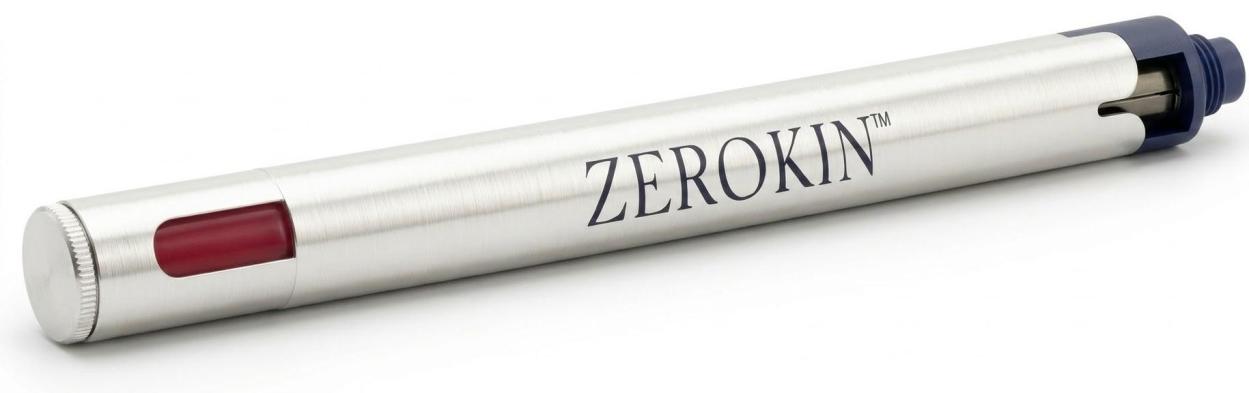
Image: Clinuvel, ZEROKIN announcement, 8 September 2026.
Put together, the idea is clear: a liquid version of a melanocortin, given with a pen-style device, potentially by patients themselves. If that were SCENESSE, it would remove most of bitopertin's convenience advantage. Clinuvel's Singapore expansion, backed by the Singapore Economic Development Board, is due to finish its first phase late this year and be operational in early 2027.
There are three reasons not to get ahead of this:
- It's preclinical. No human has received a VLRX-L formulation. A liquid afamelanotide would need clinical studies and its own FDA approval before it could replace the implant.
- The timeline has already slipped. The program was meant to complete preclinical work in H2 2026; it now needs another preclinical study in Q1 2027.
- Clinuvel hasn't said it will be SCENESSE. The announcements describe a platform for "melanocortins and other peptides". They don't name a product or a target dosing interval.
Our estimate is that a self-administered version of afamelanotide is unlikely to reach patients before about 2030, three years after bitopertin's likely US launch. It could help Clinuvel keep EPP patients in the 2030s, but it can't stop bitopertin taking new patients from 2027. We give it no value in the model below. It's a real option, not a cash flow yet.
Vitiligo: what the December readout can and can't do
Vitiligo is the reason Clinuvel is spending A$18m a year on R&D rather than just collecting EPP profits. It's a much larger market. Clinuvel puts the number of affected Americans at about six million, compared with 5,000 to 10,000 EPP patients worldwide.
The approach
SCENESSE alone doesn't repigment the skin. Clinuvel's pilot study showed this. It has to be combined with narrowband UVB phototherapy (NB-UVB), the current standard treatment, which involves light sessions two to three times a week. The idea is that NB-UVB activates melanocyte stem cells, and afamelanotide then drives melanin production. Clinuvel is targeting patients with extensive disease (at least 10% of body surface) and darker skin.
CUV105: results due December 2026
| Detail | |
|---|---|
| Patients | 210, across 37 sites |
| Population | Fitzpatrick skin types III-VI |
| Design | SCENESSE + NB-UVB vs NB-UVB alone |
| Treatment | 20 weeks |
| Primary endpoint | % of patients achieving T-VASI50 (≥50% total-body repigmentation) |
| Secondary endpoint | % achieving F-VASI75 (≥75% facial repigmentation) |
| Topline results | December 2026 |
So far Clinuvel has released case studies, not trial data. Physicians have published 12 case reports, and at EADV in October Clinuvel showed two new cases plus one shown earlier. All three responded, and their repigmentation kept improving for up to 24 weeks after treatment stopped. Case studies are selected examples, so they show the drug can work in some patients. The December result will show how often it works across the trial, compared with NB-UVB alone.
The benchmarks
In July, Clinuvel published the benchmarks it thinks CUV105 should be judged against:
| Treatment | Result | Timepoint |
|---|---|---|
| NB-UVB alone (meta-analysis, 1,428 patients) | "Marked response" in 19% | 6 months |
| NB-UVB alone (same meta-analysis) | 36% | 12 months |
| Ruxolitinib cream (Opzelura, Phase 3) | F-VASI75 in 50.3% | 52 weeks |
| Upadacitinib (oral JAK, Phase 3) | T-VASI50 in 19.4% and 21.5%, vs 5.9% placebo | 48 weeks |
| Povorcitinib (oral JAK, Phase 3) | F-VASI75 in 18.9%, vs 3.1-6.8% placebo | 52 weeks |
CUV105 measures at 20 weeks, which is less than half the duration of the oral JAK trials. Its control arm is also an active treatment (NB-UVB) rather than a placebo. To be convincing, the result needs a clear gap between the two arms on T-VASI50. If SCENESSE plus NB-UVB reaches upadacitinib's ~20% T-VASI50 in less than half the time, that would be a strong result. A small difference from NB-UVB alone, even if statistically significant, would be harder to commercialise, given the burden of implants plus two to three light sessions a week.
Why vitiligo can't save the next five years
Even if CUV105 is clearly positive, Clinuvel says two Phase 3 trials are needed. The second, CUV107 (300 patients, skin types IV-VI), is due to start this month with 12 months of recruitment, which takes it to around November 2027. After treatment and follow-up, results are unlikely before late 2028, followed by a filing and a regulatory review. Our estimate is that vitiligo revenue begins in 2030 at the earliest. That's an estimate, not company guidance; Clinuvel hasn't given a filing date.
So while bitopertin is launching (mid-2027 onwards), Clinuvel will have no vitiligo revenue to make up for it. Vitiligo is a longer-dated option. It can't protect cash flow through 2030.
Other pipeline
- NEURACTHEL Instant: a branded generic of tetracosactide (synthetic ACTH), filed in three EU countries on 30 October through the decentralised procedure. Clinuvel expects first feedback in about four months, and the review then takes 300 days plus clock stops, so approval is unlikely before 2028. Clinuvel puts the global ACTH market at US$1.3bn and its own share at US$150m, but as a generic in a few European markets to begin with, we expect a small revenue stream. Clinuvel also plans to seek US approval as a generic for central nervous system conditions later.
- NEURACTHEL modified release: a longer-acting ACTH for central nervous system conditions. Preclinical.
- PhotoCosmetics (M-lines "Preserve" and "Bronze"): consumer skin products based on Clinuvel's peptide know-how. Launch was pushed back a year, to H2 2027, "to enable the vitiligo program to be prioritised" (Annual Report 2026). Clinuvel's own estimate for the business is US$50m.
- Adolescent EPP: an EU filing to extend SCENESSE to patients aged 12 to 17. Clinuvel's February presentations said H2 2026; the FY26 presentation in August says H2 2027.
- Variegate porphyria: CUV053, a pivotal study of SCENESSE in a second light-sensitive porphyria, "has been deferred to give priority to the vitiligo clinical program."
- Canada: SCENESSE was approved for EPP in Canada in July 2026, a small new market.
The common thread is that vitiligo now has priority over everything else, and several other programs have slipped to make room for it.
Corporate events the market is pricing
Leaving the ASX
On 27 August, the same day as the FY26 result, the board said it is considering a scheme of arrangement that would put a new foreign holding company on top of the group, list it on Nasdaq and delist from the ASX. The headquarters moves to the US from 1 January 2027, with a 10-20% workforce cut. No final decision has been made. Any scheme needs shareholder, court and regulatory approval.
The stock fell 20% over the two days that followed. Some likely reasons:
- Australian funds whose mandates only allow ASX-listed stocks could be forced to sell.
- Retail holders would end up holding a Nasdaq-listed stock.
- The process costs money.
- The listing switch is based on a claim the company itself makes: that US-listed specialty pharma trades on higher multiples. That's not guaranteed for a company with a single product facing new competition.
Clinuvel points out that 66% of its register is already foreign.
Tomorrow's AGM: a possible second strike
At the 2025 AGM, 63% of votes cast were against the remuneration report, a first strike. If 25% or more vote against it again on 6 November, shareholders must vote on a board spill resolution. If that passes with more than 50%, an EGM is held to re-elect the board (excluding the Managing Director).
| Governance item | Detail |
|---|---|
| CEO Dr Philippe Wolgen, FY26 total remuneration | A$4.31m (FY25: A$5.24m) |
| As % of FY26 net profit | 12.7% |
| CEO contract | Extended to 30 June 2029 |
| CEO shareholding | 3.43m shares (6.79%) |
| FY26 dividend | 5c fully franked (A$2.5m). Clinuvel describes this as 9% of FY26 free cash |
The capital allocation question sits behind the vote. Clinuvel holds A$252m of cash, pays out a small dividend, and plans to spend on a US relocation and a vitiligo program that won't produce revenue for years. Some shareholders would prefer the cash went back to them.
Every announcement since August
Most of the recent price action has come from outside Clinuvel: Disc's data and the market's reaction to the August result. Here is everything Clinuvel has lodged with the ASX since the start of August, with the one-day share price reaction from our announcement data. Those moves are what happened around each release, not necessarily caused by it.
| Date | Announcement | What it says | 1-day reaction |
|---|---|---|---|
| 12 Aug | Injectable peptide platform | VLRX-L lead candidate chosen; more preclinical work in Q1 2027 | -2.2% |
| 14 Aug | Becoming a substantial holder | Vanguard at 5.00% | -0.4% |
| 20 Aug | Annual results webinar | Date of results briefing | +4.7% |
| 27 Aug | FY26 results, Annual Report, investor presentation, 5c dividend | Revenue -1%, profit -6%, US -15% | -13.3% |
| 27 Aug | Considers Nasdaq listing, ASX delisting | Scheme to redomicile and delist; US headquarters from 1 Jan 2027 | (same day) |
| 2 Sep | Ceasing to be a substantial holder | Vanguard below 5% | +1.5% |
| 8 Sep | ZEROKIN device | Single-use injector for controlled-release formulations; FDA 510(k) planned | -1.1% |
| 18 Sep | AGM date | AGM on 6 November | -1.4% |
| 24 Sep | Becoming a substantial holder | Vanguard back at 5.15% | -0.2% |
| 1 Oct | CUV105 cases at EADV | Two new vitiligo case studies plus one shown earlier | -4.1% |
| 2 Oct | Notice of AGM | Four resolutions including the remuneration report | -1.8% |
| 2 Oct | Change in substantial holding | JPMorgan up to 9.50%, including stock lending | +0.7% |
| 6 Oct | Change in substantial holding | JPMorgan down to 6.53% | -0.4% |
| 6 Oct | Shares issued, rights lapsed | 59,228 shares from staff performance rights; 61,272 rights expired or lapsed. 50,487,126 shares on issue | -0.4% |
| 15 Oct | Rights lapsed | 20,000 more performance rights lapsed; 749,528 rights remain | -3.8% |
| 30 Oct | NEURACTHEL Instant filed | EU dossier filed in three countries | -1.5% |
Two things stand out. First, nothing has been announced in response to Disc's APOLLO result on 19 October, which is the most important competitive event for Clinuvel this year. Second, CUV107, the second vitiligo Phase 3, was due to start recruiting in November. As of 5 November, Clinuvel hasn't announced that it has.
The share count is tidy. Performance rights convert into a small number of new shares each year, and there's no capital raising, options overhang or convertible debt. At 50.49m shares, our per-share figures use the latest number Clinuvel has notified.
Short interest
| Metric | Value |
|---|---|
| Short interest (30 October) | 9.07% |
| Shares short | 4.58m |
| Value at $7.74 | ~A$35.4m |
| 1-month average daily volume | ~168,000 shares |
| Days to cover | ~27 |
Short interest has ranged widely over the past 18 months, from 2.71% in July 2025 to a peak of 12.24% on 1 December 2025. It has stayed between about 8% and 9.5% since March 2026, so shorts have held their positions through most of the decline.
Twenty-seven days to cover is a lot. Shorts can't close out quickly on an ASX stock trading only around 170,000 shares a day without pushing the price up. That's why CUV can move sharply on news. The rally after the bitopertin rejection in February (+11.9% in a day) shows what happens when the news goes against the shorts.
Known substantial holders include Vanguard (5.15% as at 18 September) and JPMorgan (6.53% as at 1 October, down from 9.50%). JPMorgan's notice includes securities lending arrangements, so part of its interest relates to borrowed stock rather than a long investment.
The cash flow model
To see whether $7.74 makes sense, we modelled five years of cash flows (FY27 to FY31) under three EPP scenarios. Each is run twice: once with Clinuvel funding the SCENESSE vitiligo program through to a US launch (the path after a positive CUV105), and once with the program stopped (the path after a failed CUV105). The drug is the same in every case. What changes is the competition in EPP and how much Clinuvel spends trying to add vitiligo as a second indication.
Assumptions (all A$, based on FY26 actuals)
| Assumption | Value | Basis |
|---|---|---|
| Starting cash | A$252.1m | 30 June 2026 balance sheet |
| FY26 tax still owed | A$6.7m, paid in FY27 | Balance sheet |
| Cost of revenue | 16.8% of revenue | FY26 actual |
| Operating costs, vitiligo program funded | A$42m, 44m, 44m, 46m, 55m | FY26 A$37.7m, plus CUV107, US headquarters, Nasdaq move and launch preparation. Stays within Clinuvel's guidance of ≤A$55m a year average expenses excluding marketing |
| Operating costs, vitiligo program stopped | A$38m in FY27, then A$32m a year | R&D cut by about a third |
| Interest yield | 4.5% on opening cash | Below the 6.23% the portfolio currently earns, to allow for falling rates |
| Tax | 30% (85% paid in the year, 15% the following year) | Australian corporate rate, ATO instalment schedule |
| Capex and leases | A$1.75m a year | FY26 run rate |
| Dividend | 5c a share (A$2.5m) | Unchanged |
| Currency | Constant at FY26 rates | Simplification |
| SCENESSE revenue from vitiligo | Nil in all scenarios | Earliest approval ~2030 (our estimate) |
| Working capital | Unchanged | Simplification |
EPP revenue by scenario (index, FY26 = 100)
| Scenario | Market | FY27 | FY28 | FY29 | FY30 | FY31 |
|---|---|---|---|---|---|---|
| A. Bitopertin stalls (rejected again or slow uptake) | US | 95 | 97 | 100 | 103 | 106 |
| Europe | 108 | 115 | 122 | 128 | 134 | |
| B. Shared market (approved mid-2027; EU approval ~2029) | US | 92 | 80 | 65 | 55 | 50 |
| Europe | 108 | 114 | 112 | 102 | 92 | |
| C. Bitopertin dominates | US | 88 | 60 | 40 | 30 | 25 |
| Europe | 105 | 105 | 90 | 70 | 55 |
In all three scenarios, US revenue falls in FY27, since competitor trials and free supply are already reducing it. Europe keeps growing until bitopertin could be approved there.
Scenario A: Bitopertin stalls, vitiligo program funded (A$m)
| FY27 | FY28 | FY29 | FY30 | FY31 | |
|---|---|---|---|---|---|
| Total revenue | 96.2 | 100.7 | 105.6 | 109.9 | 114.3 |
| Operating costs | 42.0 | 44.0 | 44.0 | 46.0 | 55.0 |
| Operating profit | 38.0 | 39.7 | 43.8 | 45.5 | 40.1 |
| Interest income | 11.3 | 12.5 | 14.0 | 15.6 | 17.3 |
| Net profit after tax | 34.5 | 36.6 | 40.4 | 42.7 | 40.2 |
| Free cash flow (before dividends) | 28.3 | 35.0 | 38.9 | 41.1 | 38.3 |
| Cash at 30 June | 277.8 | 310.3 | 346.7 | 385.3 | 421.1 |
Scenario B: Shared market, vitiligo program funded (A$m)
| FY27 | FY28 | FY29 | FY30 | FY31 | |
|---|---|---|---|---|---|
| US revenue | 37.5 | 32.6 | 26.5 | 22.4 | 20.4 |
| Europe revenue | 56.7 | 59.9 | 58.8 | 53.6 | 48.3 |
| Total revenue | 95.0 | 93.2 | 86.1 | 76.7 | 69.5 |
| Operating costs | 42.0 | 44.0 | 44.0 | 46.0 | 55.0 |
| Operating profit | 37.0 | 33.5 | 27.6 | 17.8 | 2.8 |
| Interest income | 11.3 | 12.5 | 13.7 | 14.8 | 15.6 |
| Net profit after tax | 33.8 | 32.2 | 28.9 | 22.9 | 12.9 |
| Free cash flow (before dividends) | 27.5 | 30.4 | 27.0 | 20.7 | 10.5 |
| Cash at 30 June | 277.1 | 304.9 | 329.3 | 347.5 | 355.5 |
Scenario C: Bitopertin dominates, vitiligo program funded (A$m)
| FY27 | FY28 | FY29 | FY30 | FY31 | |
|---|---|---|---|---|---|
| US revenue | 35.8 | 24.4 | 16.3 | 12.2 | 10.2 |
| Europe revenue | 55.1 | 55.1 | 47.3 | 36.8 | 28.9 |
| Total revenue | 91.8 | 80.4 | 64.3 | 49.8 | 39.9 |
| Operating costs | 42.0 | 44.0 | 44.0 | 46.0 | 55.0 |
| Operating profit | 34.3 | 22.8 | 9.5 | -4.6 | -21.9 |
| Interest income | 11.3 | 12.4 | 13.3 | 13.8 | 13.8 |
| Net profit after tax | 32.0 | 24.7 | 16.0 | 6.4 | -8.0 |
| Free cash flow (before dividends) | 25.6 | 22.4 | 13.6 | 4.1 | -10.2 |
| Cash at 30 June | 275.1 | 295.0 | 306.1 | 307.7 | 295.0 |
All six outcomes
| EPP scenario | SCENESSE vitiligo program | Cumulative FCF, FY27-31 | Cash at 30 June 2031 | Cash per share |
|---|---|---|---|---|
| A. Bitopertin stalls | Funded | A$182m | A$421m | $8.34 |
| A. Bitopertin stalls | Stopped | A$230m | A$470m | $9.30 |
| B. Shared market | Funded | A$116m | A$356m | $7.04 |
| B. Shared market | Stopped | A$165m | A$404m | $8.01 |
| C. Bitopertin dominates | Funded | A$56m | A$295m | $5.84 |
| C. Bitopertin dominates | Stopped | A$106m | A$346m | $6.85 |
What this shows: in all six outcomes, including the worst one, Clinuvel ends FY31 with more cash than it has today. Even if bitopertin takes three-quarters of the US market and half of Europe, and Clinuvel keeps funding the vitiligo trials, the cash balance in 2031 is still A$295m, or $5.84 a share. In that worst case, interest on the cash balance keeps free cash flow positive every year until FY31, the only negative year in any of the six outcomes.
In practice, management would cut costs well before scenario C's FY31 operating loss of A$21.9m. The "vitiligo program funded" rows assume spending carries on regardless, which overstates the downside.
What the whole business is worth
The cash flow tables above answer one question: can Clinuvel survive bitopertin? (Yes, comfortably.) They don't value the business, because they give vitiligo costs but no vitiligo revenue, and ignore the rest of the pipeline. So we valued it in two steps:
- SCENESSE in EPP on its own, using the "vitiligo program stopped" cash flows. This is the floor.
- Every other program, each as a probability-weighted (risk-adjusted) net present value, added on top.
Step 1: SCENESSE in EPP on its own
Per share value is:
- cash today (less tax owed),
- plus the present value of FY27-31 after-tax operating cash flows at 10%,
- plus a terminal value of 6x FY31 after-tax operating profit, discounted.
| EPP scenario | Value per share | vs $7.74 |
|---|---|---|
| A. Bitopertin stalls | $10.93 | +41% |
| B. Shared market | $8.12 | +5% |
| C. Bitopertin dominates | $6.04 | -22% |
Sensitivity (8-12% discount rate, 4-8x terminal multiple):
| EPP scenario | Range |
|---|---|
| A | $9.53 to $12.56 |
| B | $7.53 to $8.81 |
| C | $5.99 to $6.10 |
Scenario C barely moves because most of its value is cash, which doesn't depend on discount rates or multiples.
On SCENESSE in EPP alone, $7.74 sits between scenarios B and C. That's the market's starting point, and it gives the pipeline almost nothing.
Step 2: the pipeline, program by program
Each program is valued as after-tax cash flows to FY40, discounted at 10% to July 2026, multiplied by our estimate of the chance it succeeds. Costs that are already committed count in full. Costs that only happen if a trial succeeds are weighted by the chance of getting that far. All probabilities, revenue figures and timings are our assumptions, set out so you can disagree with them.
| Program | Key assumptions | Value | Per share |
|---|---|---|---|
| Vitiligo (SCENESSE + NB-UVB) | 55% chance CUV105 succeeds, 70% chance CUV107 then succeeds, 90% chance of FDA approval after that: 35% overall. Filing 2029 (Clinuvel's plan), US launch FY31 (our estimate). Peak sales US$250m by FY35. Cost of revenue 16.8%; sales and medical costs the greater of A$30m or 25% of revenue. 4x terminal multiple | A$201m | $3.99 |
| NEURACTHEL Instant | 75% chance of EU approval; sales from FY29, A$15m peak; 40% operating margin | A$19m | $0.38 |
| PhotoCosmetics | 40% chance of a commercially meaningful launch; sales from FY28, A$15m peak; 30% margin | A$8m | $0.16 |
| Adolescent EPP (EU) | 70% chance; adds 4% to European EPP revenue from FY30 | A$2-6m | $0.05-0.12 |
| VLRX-L, ZEROKIN, NEURACTHEL modified release, variegate porphyria | Preclinical or deferred, no product or timeline to model | Nil | Nil |
Why US$250m for vitiligo? Clinuvel says about six million Americans have vitiligo, and its August presentation puts what it expects to capture at US$490-570m (footnoted as US years one and two). We use Clinuvel's figure as the high case and half of it as our central case. The treatment needs implants plus two to three light sessions a week, will compete with oral JAK inhibitors, and is aimed at the subset of patients with extensive disease and darker skin. We also run a low case of US$100m.
If vitiligo succeeds, the program is worth about A$593m, or $11.75 a share, before risk-weighting. It's by far the largest single number in the valuation, which is why December matters so much.
The sum of the parts
| A$ per share | A. Bitopertin stalls | B. Shared market | C. Bitopertin dominates |
|---|---|---|---|
| Net cash (less FY26 tax owed) | 4.86 | 4.86 | 4.86 |
| SCENESSE in EPP | 6.07 | 3.26 | 1.19 |
| Adolescent EPP | 0.12 | 0.08 | 0.05 |
| Vitiligo (risk-adjusted) | 3.99 | 3.99 | 3.99 |
| NEURACTHEL Instant | 0.38 | 0.38 | 0.38 |
| PhotoCosmetics | 0.16 | 0.16 | 0.16 |
| Total | $15.58 | $12.74 | $10.63 |
| vs $7.74 | +101% | +65% | +37% |
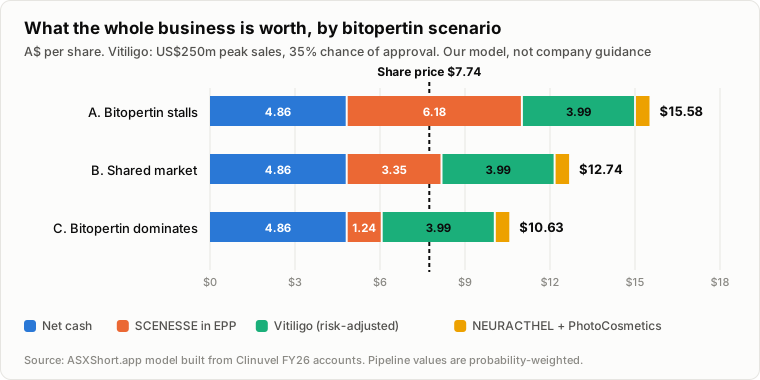
Source: ASXShort.app model built from Clinuvel's FY26 accounts. Pipeline values are probability-weighted.
How sensitive is this to the vitiligo assumptions?
| Value per share | Vitiligo peak US$100m | US$250m | US$500m (Clinuvel's figure) |
|---|---|---|---|
| A. Bitopertin stalls | $12.89 | $15.58 | $19.94 |
| B. Shared market | $10.05 | $12.74 | $17.11 |
| C. Bitopertin dominates | $7.94 | $10.63 | $15.00 |
Changing the chance of approval to 22% or 47% (instead of 35%) moves the scenario B value to $11.27 or $14.21. Using an 8% or 12% discount rate moves the vitiligo value from $3.99 to $4.90 or $3.27 a share. A one-year launch delay costs about $0.55 a share.
What December could do
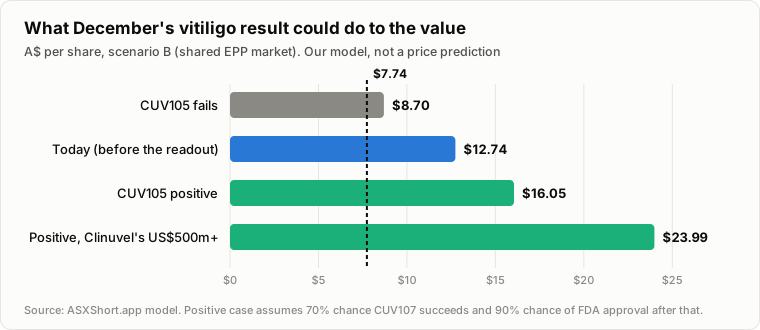
CUV105 is a binary event for the biggest part of the valuation. Once the result is known, the 55% probability goes to either 100% or zero:
Source: ASXShort.app model.
| Scenario B, A$ per share | Value |
|---|---|
| CUV105 fails (program stopped) | $8.70 |
| Before the readout (today) | $12.74 |
| CUV105 positive, US$250m peak | $16.05 |
| CUV105 positive, Clinuvel's US$500m+ | $23.99 |
Even if CUV105 fails, the remaining business is worth about $8.70 in scenario B and $6.59 in scenario C. That's the downside case, and it's not far below today's price.
What $7.74 implies
Turn the model around and ask what the share price assumes:
- In scenario B, the business without vitiligo is worth $8.75 a share, more than the share price. At $7.74 the market is valuing vitiligo at less than nothing, or is applying a discount of about A$51m to the whole company for something else.
- In scenario C, the business without vitiligo is worth $6.64 a share. The market is paying $1.10 a share (about A$56m) for vitiligo. At US$250m peak sales, that's a 10% chance of approval. At Clinuvel's own US$500m+, it's 5%.
Neither looks like a normal price for a 210-patient Phase 3 with results due in six weeks. The likeliest explanation is that the market is applying a discount for things that aren't in a cash flow model: the ASX exit, the US relocation, a second strike, and doubt that A$252m of cash will come back to shareholders. Those are real concerns. But for $7.74 to be fair value on fundamentals, bitopertin needs to dominate the EPP market and vitiligo needs to fail.
Management's view: A$7.5bn
In his letter to shareholders on 15 January 2026, Managing Director Dr Philippe Wolgen wrote: "I firmly believe that CLINUVEL can realistically attain a valuation north of A$7.5B or US$5B, given the prospect of the vitiligo, ACTH, EPP markets, formulation platforms, and the probity of financial management maintained over the past two decades."
A$7.5bn is about $149 a share, 19 times today's market value. Even our high case (scenario A, vitiligo at Clinuvel's own sales estimate, before risk-weighting) is nowhere near it. The gap between management's ambition and the market's price is one reason for the governance tension at the AGM.
How this compares with broker valuations
Broker targets have collapsed this year. Before August, several sat well above A$20: Canaccord at $27.90, Parmantier at $25 and Jefferies at $40.80. Within days of the FY26 result, Bell Potter, Canaccord and Morgans all downgraded, and Morgans cut again after APOLLO.
| Broker | Date | Rating | Target | Previous |
|---|---|---|---|---|
| Morgans | 22 Oct 2026 | Trim (from Hold) | $7.00 | $10.00 |
| Morgans | late Aug 2026 | Hold (from Speculative Buy) | $10.00 | $13.00 |
| Canaccord Genuity | late Aug 2026 | Hold (from Buy) | $9.52 | $27.90 |
| Bell Potter | late Aug 2026 | Speculative Hold (from Buy) | $11.50 | $17.00 |
| MA Financial | 31 Aug 2026 | Buy | $14.43 | n/a |
| Parmantier & Cie (Frankfurt) | 27 May 2026, before APOLLO | Buy | $25.00 | $24.00 |
| Jefferies | 31 Aug 2026 | Buy | $39.30 | $40.80 |
| S&P Global consensus (7 analysts) | as at 22 Oct 2026 | avg $16.86, median $12.97 |
Sources: FNArena, MarketScreener, StockAnalysis, The Motley Fool, Parmantier & Cie research note. The MA Financial and Jefferies figures appear only on StockAnalysis.
The brokers who have changed their view since August are at $7.00 to $11.50. Our central case of $12.74 is above that range, and the consensus average of $16.86 is above us. That average still includes older Buy targets that haven't been updated since APOLLO.
Morgans is the most bearish, and the only broker we found that has updated since Disc's data. It wrote that bitopertin's "topline data is stronger than Scenesse's pivotal package on cross-trial comparison", that it now views "EPP as a defensive franchise", and that it has "cut US volume and pricing assumptions." A $7.00 target is roughly our scenario C with only a small value on vitiligo.
Parmantier publishes its model, which shows how the more bullish valuations are built. Its May note used an 8.02% discount rate, put the chance of vitiligo approval at 75%, and treated EPP competition as low risk because the FDA had just rejected bitopertin. All three assumptions have moved against Clinuvel since then: APOLLO succeeded, and our 35% vitiligo probability is less than half of theirs.
The biggest differences between valuations come down to three questions:
- How much of EPP does bitopertin take? Between our scenarios A and C, that's worth $4.95 a share.
- What are the odds vitiligo works? Between 22% and 47%, that's worth about $3 a share.
- Does the market apply a governance discount to the cash? At $7.74, it seems to be applying a large one.
Clinuvel vs Disc: same disease, opposite valuations
| Clinuvel | Disc Medicine | |
|---|---|---|
| EPP product | SCENESSE, approved since 2014 (EU) and 2019 (US) | Bitopertin, rejected Feb 2026, resubmitting by end of 2026 |
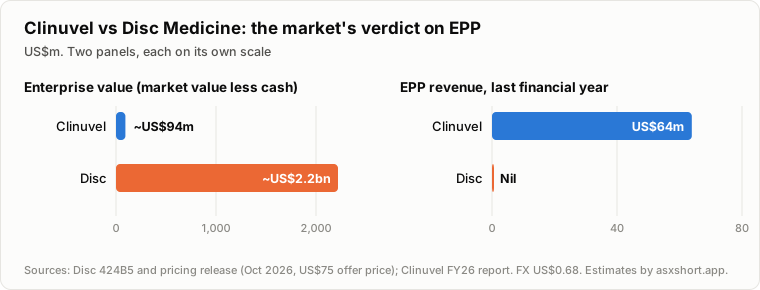
| EPP revenue, last financial year | ~US$64m | Nil |
| Profitable? | Yes: A$33.9m NPAT, 10 years without a capital raising | No |
| Latest capital raising | None | US$450m at US$75 a share (20 Oct 2026) |
| Market value | ~US$266m (A$391m) | ~US$3.3bn at the offer price |
| Cash | ~US$171m (A$252m) | US$682.8m at 30 Sep, plus the raise: about US$1.1bn |
| Enterprise value | ~US$94m | ~US$2.2bn |
Disc figures: pricing release and prospectus supplement. Market value uses 38.35m shares at 30 June plus the 6m sold, at US$75, and excludes any pre-funded warrants. Post-raise cash is our estimate, after about 6% in fees. Clinuvel converted at US$0.68, the rate implied by its own FY26 revenue figures.
Sources: Disc SEC filings (October 2026), Clinuvel FY26 report. Estimates by ASXShort.app.
The market values Disc's business at about 24 times Clinuvel's. Disc doesn't yet sell anything, while Clinuvel sells the only approved EPP drug, at a 43% operating margin.
Some of that gap is fair. Disc has earlier-stage programs outside EPP, an investor base that pays up for US biotech launches, and a pill with better data on the endpoint the FDA cares about. Bitopertin also targets X-linked protoporphyria (XLP), a related condition. But the comparison says something about how the market sees EPP. A common biotech rule of thumb values a launched drug at three to five times its peak sales. On that basis, investors are expecting bitopertin to sell something like US$450-750m a year at peak, many times SCENESSE's sales today.
That could happen if the EPP market grows a lot: more patients diagnosed, an easier-to-prescribe pill, US pricing. But in that world the EPP market is much bigger than Clinuvel's US$64m, and our scenarios assume Clinuvel's revenue only shrinks. Both stocks can't be priced right on the same disease. Either Disc is pricing in a much bigger market than Clinuvel's history suggests, or Clinuvel is priced as if it gets none of it.
Bull and bear cases
For the stock:
- Cash of $4.99 a share is real, earns interest, and in our model grows under every scenario.
- The business has 43% operating margins and a clean balance sheet. SCENESSE has been approved in Europe since 2014, with more than 21,000 doses given.
- Our whole-business value is $10.63 to $15.58 a share across the three bitopertin scenarios. At $7.74 the market is paying close to nothing for a Phase 3 vitiligo program with results due in December, worth about $11.75 a share if it succeeds.
- Even if CUV105 fails, the rest of the business is worth $8.70 a share in the shared-market scenario.
- VLRX-L and ZEROKIN could eventually give SCENESSE a self-administered form, which would narrow bitopertin's convenience advantage. We give them no value.
- Disc's US$2.2bn enterprise value suggests investors expect the EPP market to be much bigger than Clinuvel's current sales.
- With 27 days to cover, good news could push the price up sharply as shorts close.
Against:
- APOLLO succeeded, and bitopertin is likely to be approved by mid-2027. In the US, an oral pill from a well-funded competitor will probably take most new patients.
- US revenue is already down 15%, before bitopertin is even approved.
- Vitiligo needs two Phase 3 trials and a combination with phototherapy, and has no revenue before about 2030. CUV105's 20-week treatment period and active control arm make a clear win harder.
- The ASX exit, the US relocation, a possible second strike and the CEO pay structure are all reasons shareholders may not trust how the A$252m will be spent.
- If bitopertin dominates and CUV105 fails, the business is worth about $6.59 a share, 15% below today.
- The brokers who have updated since August are at $7.00 to $11.50, below our central case. Morgans, the only one to update after APOLLO, rates it Trim at $7.00.
- The new delivery platform is preclinical, has already slipped, and won't reach patients before bitopertin launches. PhotoCosmetics, adolescent EPP and variegate porphyria have all been delayed or deferred.
What to watch
| Date | Event |
|---|---|
| 6 Nov 2026 | AGM: second strike and spill vote risk |
| Nov 2026 | CUV107 pivotal vitiligo trial due to start |
| ~10 Nov 2026 | ASIC short data for today's 9.3% move |
| Dec 2026 | CUV105 vitiligo topline results |
| By end of 2026 | Disc resubmits bitopertin NDA |
| Feb 2027 | H1 FY27 results (seasonally weaker half) |
| 1 Jan 2027 | Headquarters moves to the US |
| Early 2027 | Singapore RD&I expansion operational |
| Q1 2027 | Further VLRX-L preclinical study |
| ~Feb-Mar 2027 | First feedback on the NEURACTHEL Instant EU filing |
| By mid-2027 | FDA decision on bitopertin |
| H2 2027 | PhotoCosmetics M-line launch; adolescent EPP filing in the EU |
| H1 2028 | CUV107 vitiligo trial completes (Clinuvel's timeline) |
| 2029 | Planned vitiligo regulatory submission |
| TBC | Scheme booklet for the Nasdaq redomicile and ASX delisting |
Summary
Clinuvel is a profitable company with a net cash balance worth 64% of its share price. It's also about to lose its monopoly in its only market. Both are true, and the stock's fall reflects the second. After APOLLO, the question is no longer whether bitopertin gets approved but how much of the market it takes.
On SCENESSE in EPP alone, the market's pessimism is understandable: $7.74 sits between our "shared market" and "bitopertin dominates" cases. But that ignores the rest of the business. Valued as a whole, with vitiligo given only a 35% chance of approval and the delivery platform given nothing, Clinuvel is worth $10.63 to $15.58 a share on our numbers. For $7.74 to be fair, bitopertin has to dominate and vitiligo has to have less than a 10% chance of working.
There are reasons the market might be doing exactly that. The brokers who have updated are at $7.00 to $11.50. Clinuvel is leaving the ASX, cutting staff, moving to the US and facing a possible second strike tomorrow, and investors may simply not trust how A$252m will be spent. Disc's enterprise value, meanwhile, is about 24 times Clinuvel's on the strength of a drug that hasn't been approved yet.
The cash gives a floor: even in the worst operating case, cash grows to about $5.84 a share by 2031. The December CUV105 result will settle the biggest open question. A clear win would make the current price hard to justify. A failure would leave a cash-rich, shrinking EPP business worth roughly $6.60 to $8.70 a share. With 9% of the stock short and 27 days to cover, either way the move is likely to be sharp.
Disclaimer: This blog post is for informational and educational purposes only and is not financial advice. The cash flow model and sum-of-the-parts valuation are illustrative and based on our own assumptions, set out above, including the probabilities of success, peak sales and launch timing for each pipeline program. Broker targets are as reported by third-party aggregators and may have changed. It is not a forecast by Clinuvel, and actual results will differ. Data is as of 5 November 2026; short position data is as at 30 October 2026. Today's price data is from a delayed third-party quote. Clinuvel is a single-product pharmaceutical company with significant competitive, regulatory, clinical and corporate-structure risks. You should do your own research and consult a qualified financial professional before making any investment decisions. ASXShort.app does not guarantee the accuracy or completeness of the data presented, nor does it guarantee future stock performance.
Sources:
- Clinuvel Appendix 4E and Annual Report 2026 (27 August 2026)
- Clinuvel: A decade of profitability provides U.S. expansion foundation (27 August 2026)
- Clinuvel considers Nasdaq listing, ASX delisting (27 August 2026)
- Clinuvel strategic reorganisation to refocus on U.S. markets (23 July 2026)
- Update: SCENESSE in vitiligo (28 July 2026)
- Commercial update on vitiligo (30 July 2026)
- New CUV105 vitiligo cases presented to EADV (1 October 2026)
- Clinuvel files NEURACTHEL Instant dossier (30 October 2026)
- Clinuvel Half Year Results (26 February 2026)
- Clinuvel Clinical & Financial Update, Jefferies (2 February 2026)
- Clinuvel reports highlights from AAD 2026 (2 April 2026)
- SCENESSE approved for EPP in Canada (13 July 2026)
- Clinuvel Investor Presentation, FY26 (27 August 2026)
- Clinuvel Managing Director Letter to Shareholders (15 January 2026)
- Clinuvel to advance novel formulations in preclinical program (29 September 2025)
- Clinuvel controlled-release injectable platform in preclinical study (12 January 2026)
- Clinuvel's injectable peptide platform (12 August 2026)
- Clinuvel develops proprietary ZEROKIN device (8 September 2026)
- Clinuvel Appendix 2A and 3H share notices (6 and 15 October 2026)
- Disc Medicine pricing of US$450m upsized offering (20 October 2026)
- FNArena: Clinuvel broker ratings
- MarketScreener: Clinuvel consensus
- StockAnalysis: Clinuvel analyst forecasts
- The Motley Fool: Morgans on Clinuvel (23 October 2026)
- Parmantier & Cie: Clinuvel research update (27 May 2026)
- Disc Medicine 8-K: APOLLO Phase 3 topline results (19 October 2026)
- Disc Medicine preliminary prospectus supplement (19 October 2026)
- FDA issues CRL to Disc Medicine for bitopertin (PharmExec)